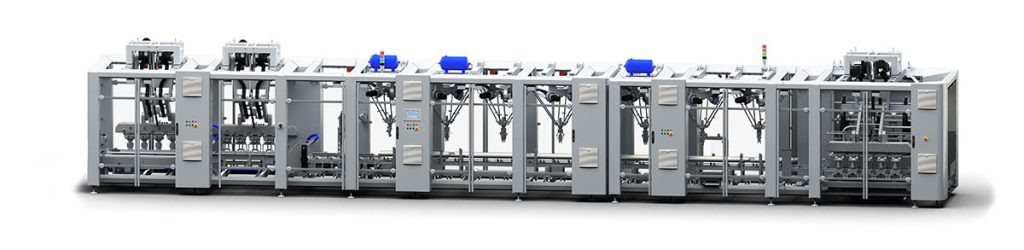
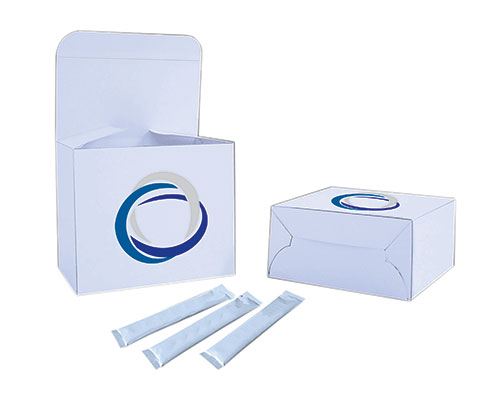
 Cama’s solution involved deploying its in-house-developed robotic technology to gently pick up stick packs and load them into boxes according to product counts dictated by the box size and batch parameters, which included flexibility for future variations in products and packaging dimensions. The pick-and-place operations for the products are augmented by robotic box forming and closing procedures. “Powder stick packs present a significant challenge,” Melli notes. “They are quite small, only 80 mm long and 22 mm wide, containing about five or six grams of powder. We had to consider this when packaging them in arrays of eight to fifty per box. During operation, the bagging machine discharges ten pieces per cycle, arranging them in a line on a 600 mm wide FDA-compliant smart transport conveyor belt. The Cama machine then uses advanced vision systems to identify their positions on the belt before guiding the robots to pick up and orientate them according to the requested packaging style.”

“We have extensive experience in applications of this nature,” Melli continues, “due to our widespread deployment in other markets, where our new-generation machine portfolio sets the standard for flexibility and efficiency. We offered the customer several models to develop this new pharma technology, giving them a variety of core operating principles to choose from. Thanks to our tightly integrated robotic technology and advanced vision systems, the customer received precisely what it needed, with added flexibility to adapt the machine for future output and packaging format demands.”
“Side loading could be easier and faster for this type of application,” Melli admits, “and is typically what other machine suppliers might offer, often pushing this technology due to their limited machine portfolios. However, side loading would not have met all of the customer’s requirements, particularly regarding easy open and reclose boxes. Our top-loading solution, on the other hand, addressed all the customer’s needs. Indeed, the customer chose our solution over existing technologies in its workshop. The consensus was that while side loading might be faster, it was not the optimum solution for their needs.”
“We worked very closely with this customer,” Melli concludes, “to develop an advanced solution that fulfilled 100% of their requirements. We believe it’s important to remain open-minded with our customers, as many suppliers tend to push only the limited technology they possess, whereas we are able to offer multiple solutions, all based on industry-proven concepts.”