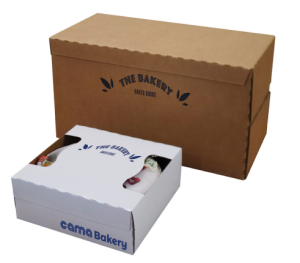
New machine, new boxes, smaller footprint, and greater flexibility. Automated secondary packaging eclipses manual capabilities.
When production throughput reaches a certain volume, there comes a point when even the most heavily populated manual packaging operations simply cannot keep pace. In addition, higher throughput and faster speeds often result in more packaging errors and product damage and, as a direct result, quality and output begin to suffer.
Higher throughput and higher accuracy

This is why many companies are exploring the flexibility and capabilities offered by automated secondary packaging. Automation not only supports higher throughputs but also provides more consistent accuracy and quality, and greater cost-effectiveness, usually while taking up much less space within the factory. It is a common misconception that speed and throughput compromise flexibility; however, Cama Group has debunked this myth at a North American baked-goods company by introducing a packaging solution that has redefined industry standards, revolutionizing the company’s secondary packaging operations. The Cama solution not only meets the demand for higher throughput but also achieves this with a more efficient packaging design within a smaller-footprint monobloc machine, replacing two previous systems. Moreover, the customer is offered the versatility to pack products into cartons and then six cartons into cases or to package 6 or 12 loose products directly into cases, thanks to a bypass solution integrated within the machine’s footprint. The US company specializes in producing baked goods, which are presented in trays and sealed in bags that are gathered at the neck. With growth in its home market, there has been an increase in demand for its products, leading to the need for a highly capable and fully automated secondary packaging system to supersede its previous manual and machine-based operations. The customer was satisfied with its existing primary packaging design and did not wish to alter the presentation of its secondary packaging, some of which includes multipack cartons that can be converted into shelf-ready trays.
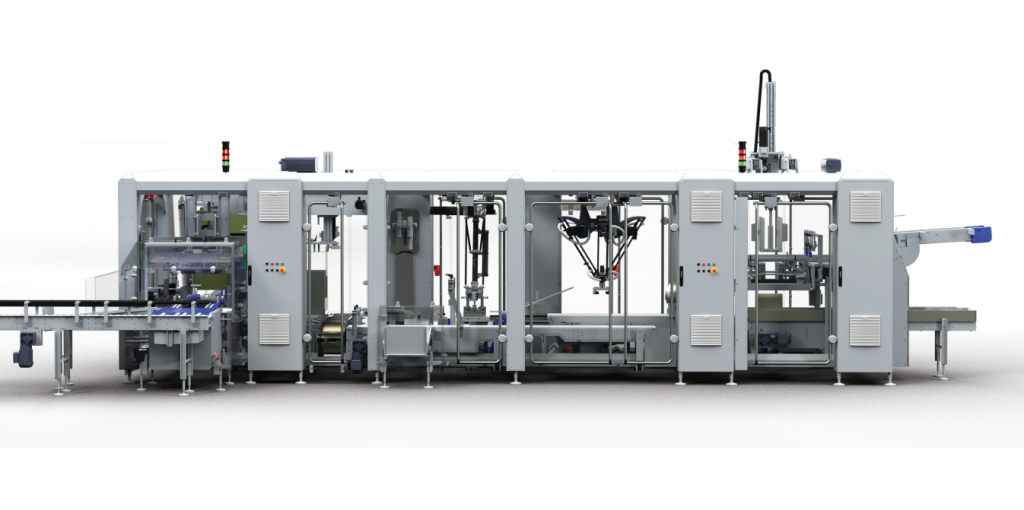
Smaller and less complicated
According to Davide Di Lorenzo, Sales Engineer Manager at Cama Group: “The customer was happy with its existing shelf-ready presentation for certain packaging formats, but was using pre-glued RSC cases, which place far greater demand on packaging operations. Our packaging design team worked with the customer to develop a wraparound carton, which offered identical aesthetics and shelf-ready tear offs, but could be formed and fed from a blank magazine, in a process that is far less complicated and takes up less real estate.”
In operation, the machine receives the frozen bagged baked goods from the downstream bagger. A vision system detects the position of the bag tails before they are inserted into the concurrently formed wraparound carton, the vision system ensures the robots orient the packs in such a way that the tails are positioned near the hinges of the carton, preventing them from fouling any of the glue points. The cartons are then closed before being transferred to an integrated wraparound case packer, where they are packaged ready for shipment.
Bypass delivers greater flexibility
The customer also required a solution where 6 or 12 products are loose packed directly into cases, which exhibit different dimensions depending on the height of the product being packed – one is 38 mm the other 52 mm. Cama was able to achieve this functionality in the same machine envelope by incorporating an integral bypass conveyor, which takes the loose products around the carton packaging stage and straight to the case packing. Once again using a robots and vision systems to ensure perfect orientation, packing and closure. “This multi-function monobloc machine not only meets the customer’s needs in terms of throughput, but it does so with many other value-added advantages,” Davide explains. “Not only are material and material-stocking costs far cheaper, but the machine also takes up less space and the employees it replaces can be moved to more value-adding activities.” The monobloc machine exploits the design rationale behind Cama’s Breakthrough Generation (BTG) concept, which sees modular, scalable and hygienically designed frameworks housing contemporary automation solutions. This includes advanced servo technology, which is tightly coupled to vision systems and Cama’s robotic solutions, which have been developed in house to deal with the specific demands of secondary packaging.
Digital capabilities
The machines are also based on a 100 per cent digital platform that supports full Industry 4.0 capabilities, including AR, VR and virtual testing, training and operation. Furthermore, advanced component-identification systems can deliver rapid format changeovers, sometimes in as little as 15 minutes.


